One note a month on AI security, from the people building the harness
What went wrong in the world, what it means for your agents, and what we changed because of it. No product announcements.
Reading progress: 0% complete
What went wrong in the world, what it means for your agents, and what we changed because of it. No product announcements.

We saw attacks on our infrastructure and went through the logs. What limited them was controls we already had: least privilege, no long-lived keys, private storage, named callers. Eight fundamentals, three attacks, and the commands to test your own.
Adesh Gairola, Founder, raxIT Labs
The Weir Below the Wood. A wide slow lowland river under soft grey overcast morning light, a dark wooded escarpment filling the left of the frame down to the water.
We've seen attacks on our infrastructure, from the internet, from someone holding a valid API key, and from inside. When we went through the logs, the useful finding wasn't anything clever on our side. It was controls we already had in place, mostly boring ones, doing their job.
We have a saying at raxIT Labs: eat your security vegetables. This post is what that looked like in practice. Least privilege, no keys that outlive the job, nothing public that doesn't need to be, and logs we could actually read afterwards. It doesn't stop someone holding a valid credential outright. It limited what they could reach, and the logs told us what happened. None of this is AI security, really. It's security, applied to a system that now has something automated poking at it at three in the morning.
The moves look a lot like the ones in the public reports on ARTEX, an AI pentesting framework used in several intrusions this autumn. On 13 November the FBI put out a FLASH advisory on it: some intrusions went "from initial targeting to privileged access in under three hours." I'm not claiming any of our attackers used it. The line from the advisory I keep coming back to is that ARTEX "generates high volumes of forensically noisy traffic that may trigger alerts," but moves fast enough that there's little time to respond. That's this post in one sentence. The basics catch the noise. Speed is what you plan for.
The FBI's list of recommendations reads like a list of security vegetables. Inventory every internet-facing app, including the forgotten ones. Restrict cloud administration to trusted paths. Rate-limit and authorize every lookup. Scan your repos and pipelines for secrets. Nothing in it needs an AI product. If your response starts when someone gets to the ticket queue on Monday, three hours is a problem.
Here's what came in, in three groups. We run on AWS and Google Cloud, so the attempts landed on both.
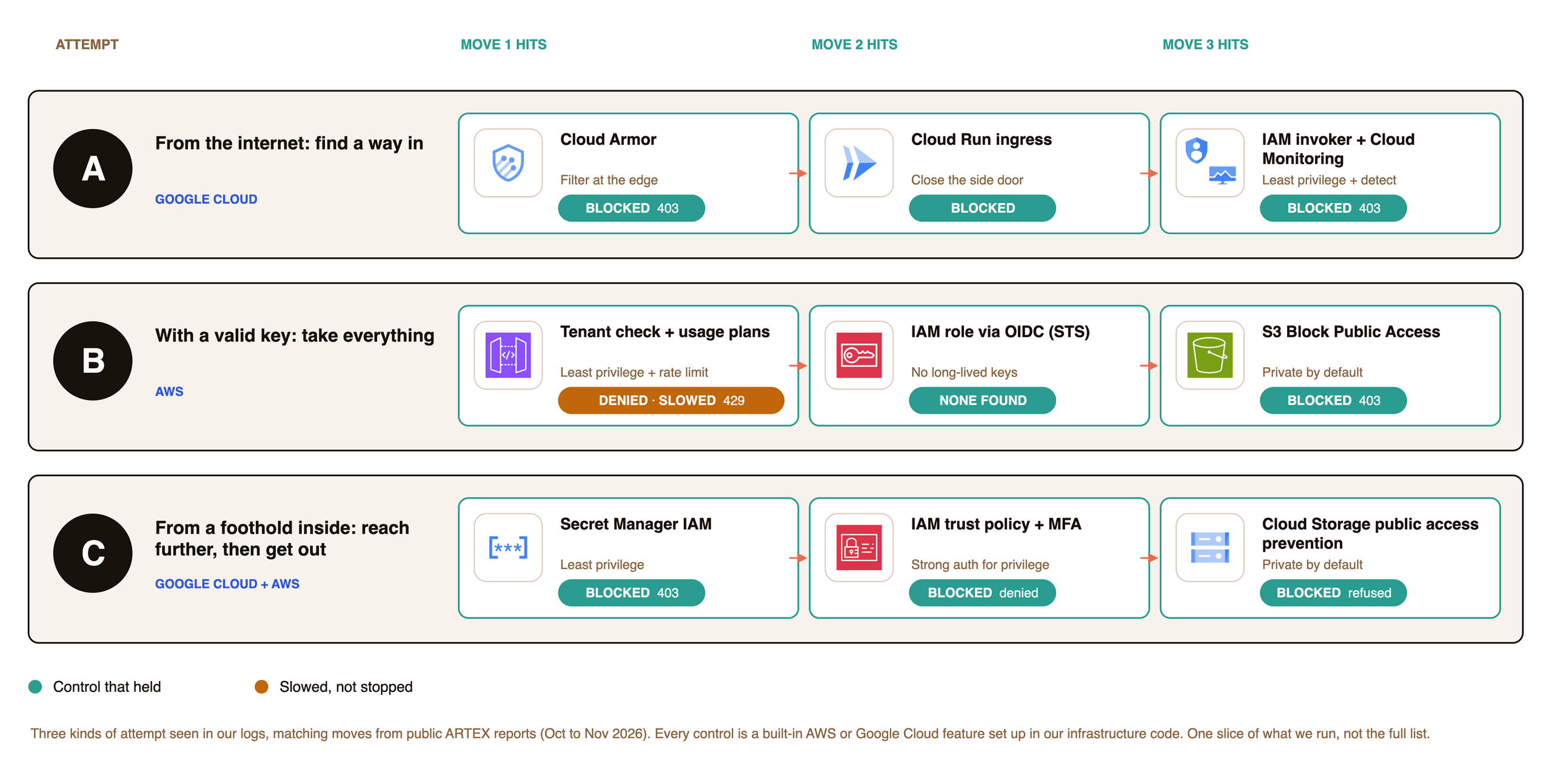
You don't have to boil the ocean to stop any of that. These are the eight fundamentals we work from. They were in place when the attacks came in, and they did the catching.
| The vegetable | What we already had | Where it helped |
|---|---|---|
| People don't read customer data | Storage private by default, set in code; MFA on the privileged role | Attempts B and C |
| Every identity gets its own things and nothing else | Per-worker secret grants, tenant checks on every lookup, named callers only | Attempts A, B and C |
| No keys that outlive the job | Temporary credentials and federation, no long-lived cloud keys in apps | Attempt B |
| Know every front door, and the back one out | Edge rules, ingress locked to the load balancer, egress you can name | Attempt A |
| Log the reads, and make sure a person sees them | An organisation audit trail in its own account, read logging on the stores that matter, alerts routed to on-call | Attempts B and C |
| Write it as code, then prove the code tells the truth | Terraform and CDK, plus checking what's actually live | Attempt C |
| Rehearse pulling a credential that's already out there | A runbook and timed containment drills | Attempts A and C |
| Leave traps for whatever is noisy | Canary values in our data pipeline, and decoy credentials nothing legitimate uses | Attempts B and C |
If I could only keep one, it would be the first. Most of the rest exists to make the first one hold.
The attempts below ran into more than individual settings. Underneath them is how the platform itself is built, so a mistake in one place can't reach the rest. It's the same vegetables, applied to the foundations.
Separate accounts. An AWS Organization with separate units for security, deployments, workloads and sandboxes, all defined in CDK. The core app and the customer-access broker each run in their own accounts, and new accounts come out of a StackSet ready to deploy into, with no laptop step.
A broker for customer access. Customer cloud and GitHub access goes through a broker in its own account. Every run gets a ticket tied to a tenant and a purpose. Calling the broker directly is denied by organisation-wide policy, and a refusal raises an alarm.
A deploy pipeline that ships only what was approved. The approval shows the commit and a hash of the exact build, and the deploy step refuses if the hash changed. The step that runs repo code holds no cloud credentials. The FBI lists CI/CD pipelines among the ways ARTEX pivots from a supplier into its target.
An audit trail the workloads can't touch. An organisation CloudTrail into a separate log-archive account. A compromised workload can't edit the record of what it did.
Humans kept away from customer code. When we scan a customer's repo, it's read inside an ephemeral microVM. Nothing lands in durable storage or tracing, and a person on our side who tries to read it is denied by IAM rather than trusted not to look. That's fundamental 1 applied to our own product.
On Google Cloud, we closed default-network SSH and RDP to Google's IAP range, turned on OS Login and dropped project-wide SSH keys.
Here's each of the three attempts in detail, and what we found when we went back through the logs. I'm not claiming any of them was ARTEX, and from a log line you mostly can't tell whether a person, a script or an agent is on the other end. It doesn't change the response.
The excerpts are trimmed and redacted from our logs, with IPs, keys, names and hostnames swapped for placeholders. I've left out detail that would mostly help someone probing us. For each one I've written what was already in place, what it caught, what still got through, and what our runbook says to do next.
Already in place. Edge rules on the load balancer, Cloud Run ingress locked to it, and a single named invoker on the internal service. Security at every layer, and only named callers get in.
The first thing anyone reaches is our web app, which checks the session on the server for every request. Behind it, our public API sits behind a Google Cloud load balancer. This group probed that API, tried to go around the load balancer, then sent an identity token to a separate internal service that doesn't accept it.
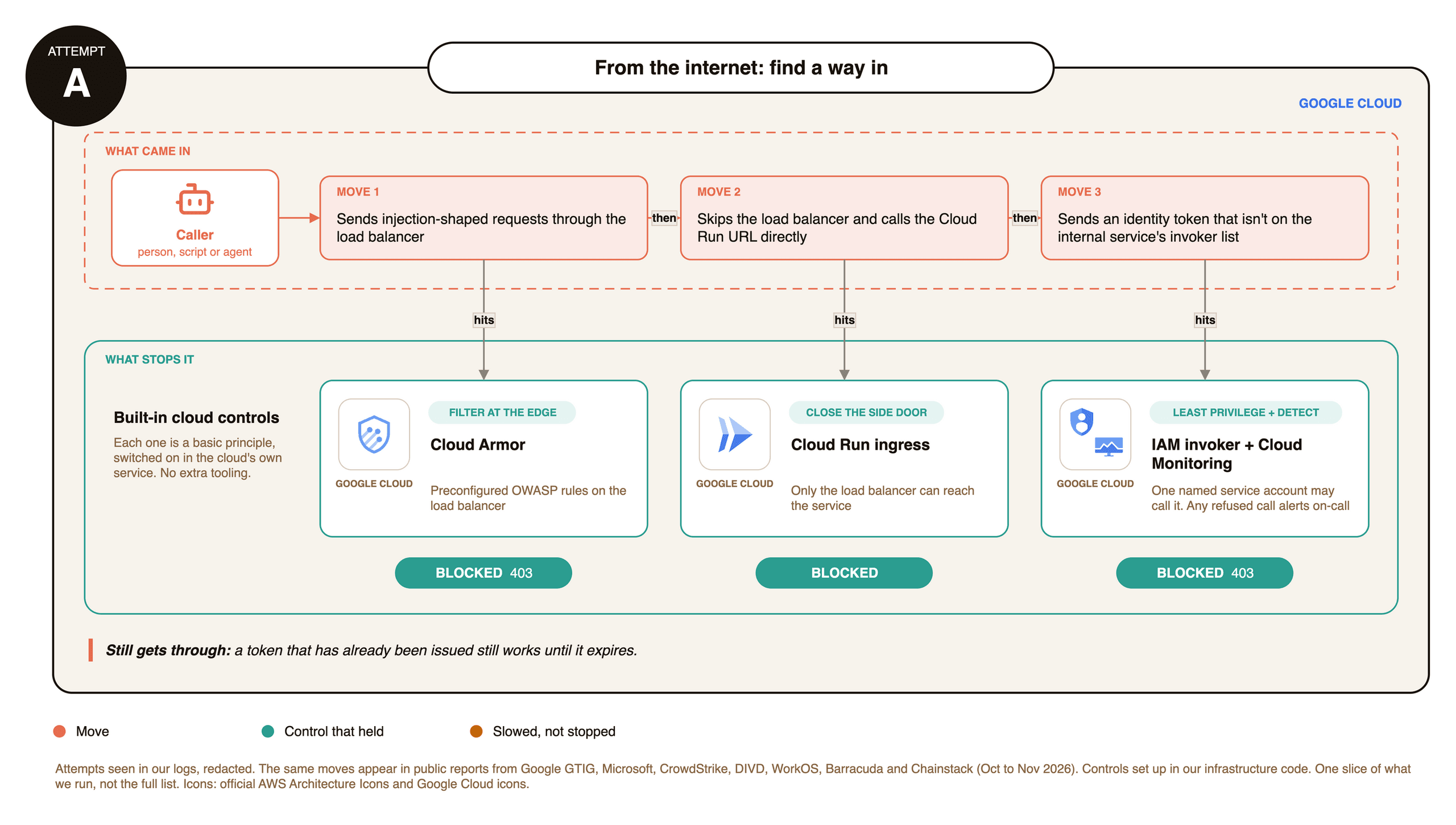
Move 1: probe the API. This one showed up in our Cloud Armor logs. The preconfigured OWASP rules answered with a 403, and the log names the rule that fired.
{
  "httpRequest": { "requestMethod": "GET", "status": 403, "remoteIp": "203.0.113.47",
                   "requestUrl": "https://api.example.com/v1/search?q=1%27%20UNION%20SELECT%20NULL--" },
  "jsonPayload": {
    "statusDetails": "denied_by_security_policy",
    "enforcedSecurityPolicy": { "outcome": "DENY",
                                "preconfiguredExprIds": ["owasp-crs-v030301-id942100-sqli"] }
  }
}
Try it on your own load balancer:
curl -i "https://<your-load-balancer>/search?q=1%27%20UNION%20SELECT%201--"You want a 403 from the edge. A 200 or 500 means nothing at the edge blocked it. Check the policy is attached to that backend, the rule isn't in preview mode, and the sensitivity level catches this payload.
Move 2: skip the load balancer. This is the move WorkOS described, going around the front door and calling the service directly. Edge rules only see traffic that comes through the edge. Our public API's Cloud Run ingress only accepts traffic from the load balancer, so the direct URL gets an error before our code runs.
curl -i https://<your-service>.run.app/
If that returns your app, ingress is set to all. Change it to internal-and-cloud-load-balancing.
Move 3: a token that isn't on the list. The call carried a Google identity token, but only one named service account may invoke that internal service, so Cloud Run refused it with a 403 in its request log.
{
  "logName": "projects/example-project/logs/run.googleapis.com%2Frequests",
  "resource": { "type": "cloud_run_revision" },
  "httpRequest": { "requestMethod": "GET", "status": 403, "remoteIp": "198.51.100.23",
                   "userAgent": "curl/8.7.1" },
  "severity": "WARNING"
}
Notice what that log doesn't tell you. There's no caller identity in it. A 403 only proves the caller wasn't the allowed invoker, and any Google account's token would get the same answer. The one caller that's allowed in has no reason to get a 403 from that service, so any 403 there is worth a look.
Detect. What we alert on: Cloud Armor DENY counts per source, and any 403 from the internal service, routed to on-call.
Respond. Work out whose token it was. The request log won't tell you. If it belongs to one of our people, we revoke their sessions and OAuth grants in the identity provider, then reset the credential. Then we pull every audit entry for that principal across projects for the token's lifetime and ask what else this identity could call that we didn't gate.
Still gets through. The token is refused here, but until it expires it still works on anything else that identity is allowed to call. That's why Respond pulls everything the principal touched. Fundamentals 2 and 7.
Already in place. A tenant check on every lookup, a usage plan per API key, no AWS keys in the web app, and Block Public Access on tenant data. Every identity gets its own data and nothing else.
This group came in with a valid API key. It walked record IDs, looked for long-lived AWS keys in the web app, then tried to fetch an export straight from S3.
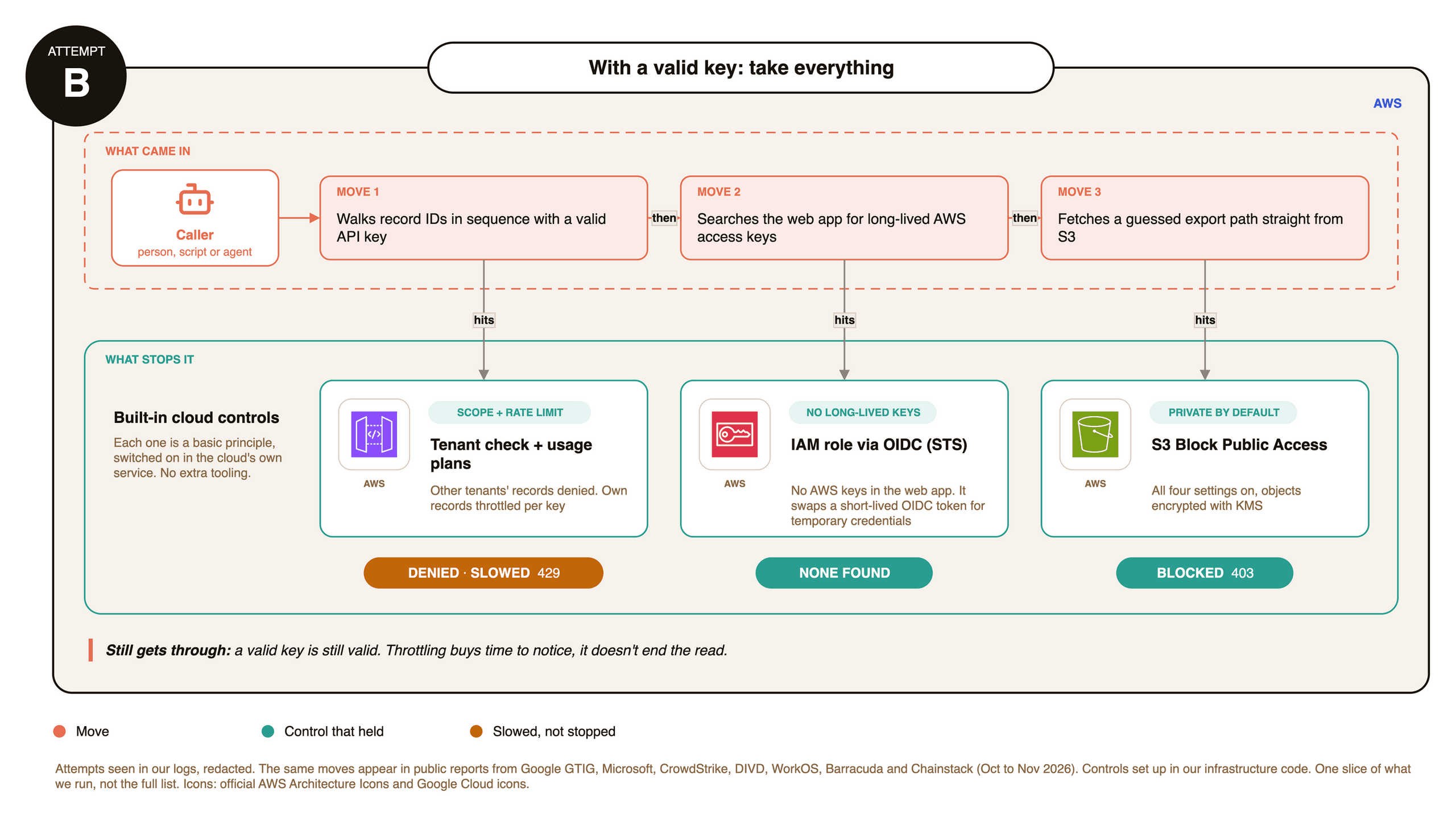
Move 1: walk the IDs. Every lookup is checked against the key's tenant, so IDs belonging to someone else come back denied whatever the rate. That's the control that matters most here, and it's fundamental 2. It's also close to word for word what the FBI recommends for partner and employee portals: alert on sequential lookups, rate-limit the endpoint, and enforce server-side authorization on customer records.
Throttling comes second. WorkOS had no rate limit on bulk retrieval. Our API Gateway gives each key a usage plan with a throttle and a quota, so a key walking IDs starts getting 429s. From our access log, with the IDs replaced by the caller's guesses:
{"apiKeyId":"exampleKeyId123","ip":"203.0.113.88","path":"/v1/records/<id-1>","status":"200"}
{"apiKeyId":"exampleKeyId123","ip":"203.0.113.88","path":"/v1/records/<id-2>","status":"429"}
Try it with a test key and two test tenants. Tenant A should be denied tenant B's record on the very first request. Then see what happens when A reads its own records over and over:
for i in $(seq 1 200); do
  curl -s -o /dev/null -w "%{http_code}\n" -H "x-api-key: $TEST_KEY" "https://<your-api>/v1/records/$i"
done | sort | uniq -c
Some 429s mean the plan is doing its job. Two hundred 200s mean the limit sits above this traffic, or the method doesn't require a key at all. Either way, don't lean on a usage plan alone. Put a WAF rate-based rule or an app-level limit in front as well. Start it in Count mode and look at real traffic before picking a threshold, because a support office can put hundreds of legitimate users behind one IP.
This move is amber on the diagram for a reason. Throttling slows a valid key down. It doesn't stop it. The run of sequential IDs is what a person should act on.
Move 2: look for cloud keys. This found nothing. The web app holds no AWS keys. It swaps a short-lived OIDC token for temporary credentials. Check your own app repo:
grep -rnE "AKIA[0-9A-Z]{16}" .Run it against the build output and git log -p too, or use a secret scanner over the full history. A key deleted in a later commit, or inlined into a client bundle, is exactly what an outsider finds. A match is a long-lived access key. Move that app to an OIDC role and delete the key in IAM, because deleting it from the repo leaves every copy working.
Move 3: go straight to S3. Block Public Access has all four settings on for our tenant data.
curl -i https://<your-test-bucket>.s3.amazonaws.com/dummy.txt
Expect 403 AccessDenied. That only proves the bucket is private, because any private bucket says the same. Also try to attach a public bucket policy or ACL to a private test bucket and confirm it's refused. Signed links get through by design, so review who can issue them and how long they last. A bucket can pass every check while an old signed URL still grants access.
Detect. Sequential IDs from one key, or a high 429 ratio per key, should raise an enumeration alert rather than sit on a throttling graph. Secret scanning in CI should catch the AKIA case before it ships.
Respond. If a key is walking IDs, we disable it and issue a new one through the account owner. Pulling the access log runs on its own. Disabling a customer's key needs a human yes. Every 200 for that key across the whole window, not just before the first 429, plus whatever each list or search response returned, is the notification scope. Then we read the S3 data events in our organisation trail to see who touched the export path.
Still gets through. A valid key is still valid. Throttling buys time to notice. Fundamentals 1, 2 and 3.
Already in place. Secret grants per worker rather than per project, an MFA condition on the privileged AWS role, and public access prevention on Cloud Storage. Least privilege for machines too.
The third group worries me most. These are denials logged against a workload identity. It asked for a neighbour's secret, tried to assume a privileged AWS role and tried to make a bucket public. That's what a compromised worker would produce.
Three denials tell you something asked for things it shouldn't. They don't tell you why. Our runbook treats the worker as compromised until we can show otherwise, so that's what the steps below assume.
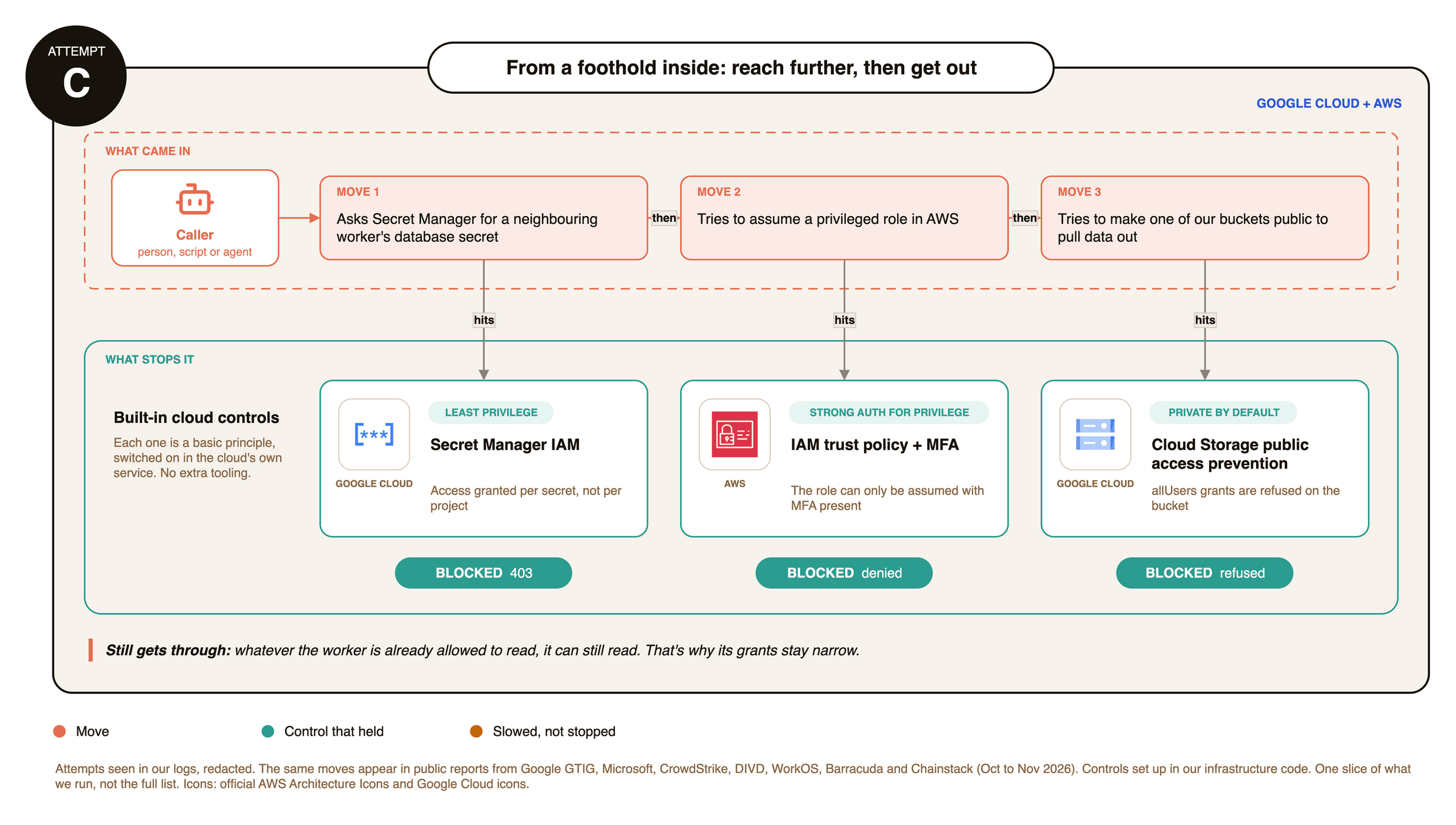
Move 1: a neighbour's secret. Each worker gets Secret Accessor on its own secrets, not on the project. Test it with dummy secrets so nothing real ends up in your terminal:
gcloud secrets versions access latest --secret=<dummy-secret-of-worker-b> \
  --impersonate-service-account=<worker-a-service-account>
Expect PERMISSION_DENIED. If it prints the value, look for a Secret Accessor grant at the project level.
Move 2: a privileged role. That role can only be assumed with MFA present, and a worker can't do MFA, so the request is denied. The MFA condition is really there for the human path, which is fundamental 1 doing its job. To test it:
aws sts assume-role --role-arn <privileged-role-arn> --role-session-name mfa-test
Run it from credentials that were not issued with MFA, such as a long-term test user's key rather than your SSO session. Otherwise your session already carries MFA and the test proves nothing. Without --serial-number and --token-code you want AccessDenied. If you get credentials back, the trust policy is missing an aws:MultiFactorAuthPresent condition.
Move 3: make a bucket public. Cloud Storage public access prevention refuses any grant to allUsers. One wrinkle: an identity with storage.buckets.update can switch it off, unless the storage.publicAccessPrevention org policy constraint enforces it. Google's public access prevention docs cover both. Test it on an empty bucket made for the test:
gcloud storage buckets add-iam-policy-binding gs://<empty-test-bucket> \
  --member=allUsers --role=roles/storage.objectViewer
It should be refused. If it goes through, undo it straight away and switch prevention on:
gcloud storage buckets remove-iam-policy-binding gs://<empty-test-bucket> \
  --member=allUsers --role=roles/storage.objectViewer
gcloud storage buckets update gs://<empty-test-bucket> --public-access-prevention
Detect. This is the strongest signal in the post. A healthy workload almost never gets PERMISSION_DENIED on a secret, AccessDenied on AssumeRole or a refused IAM policy change. Any one of those from a workload identity should page someone. We see the secret denial because Data Access logs are on for Secret Manager, which is fundamental 5. If yours aren't, this alert can't fire.
Respond. Shift traffic off the worker and scale it to zero, or, if it routes all egress through the VPC, apply a deny-all egress firewall rule. Keep its logs. Scaling a staging worker to zero can run on its own. For a production service, a person approves it. Disable the service account, accepting that this stops every job sharing it. Rotate every secret it could read. Compare the running image digest with the build and redeploy from a known-good one. Then read the Data Access logs for what it did read, and the egress logs for where it went.
Still gets through. Whatever the worker is already allowed to read, it can still read. That's why its grants stay narrow. Fundamentals 1, 2, 5 and 7, with 6 for the rebuild.
We're building this kind of authority model, what runs on its own and what waits for a person, into the raxIT App. Not all of it runs on its own today, and I'd rather say that than pretend.
None of these came from a framework slide. Each one is here because I've watched it be missing somewhere. In the cloud work I've done, the problems I ran into were rarely new. They were the basics, half done. Agents haven't changed that much.
The runnable tests live in the attempts above. Below is the principle, what we do, and any check that didn't have a home up there. Run checks only against systems you own.
The best way to keep data safe from a compromised human is to make sure no human needs to touch it in the first place.
The rule is that nobody on our team has standing read access to tenant data. The privileged role that can get near it needs MFA. When something goes wrong, we want responders working from logs, not opening the data.
Storage is private by default and set that way in code. Our CDK sets all four S3 Block Public Access options on tenant data, and our Terraform enforces public access prevention on Cloud Storage.
Stopped: attempt B move 3, attempt C moves 2 and 3.
A stolen credential is a valet key at best. The useful question is always what the caller can read next. Microsoft observed stolen application credentials being used for follow-on access, which is that question answered badly.
Our Google Cloud worker module grants Secret Accessor on individual secrets rather than the whole project. That grant is easy to review in a change. Permissions inherited from elsewhere still count, as Google's Secret Manager guidance points out. Tenants are identities too, which is why every API lookup is checked against the key's tenant.
The same goes for whatever a compromised web process can reach. CrowdStrike saw a route from a web application to cloud metadata. On EC2, require IMDSv2 where instance metadata is needed and disable the endpoint where it isn't. On Cloud Run, give each service a dedicated service identity.
Check. Pick one private database or admin API the web service has no business using. Check the network path and the caller's permissions separately. A reachable API that refuses the caller and an unreachable API need different evidence. AWS Reachability Analyzer answers the first and Google's Policy Troubleshooter the second.
Stopped: attempt A move 3, attempt B move 1, attempt C move 1.
CrowdStrike's Greek government case involved keys from a 2022 export. My cloud version of that nightmare is a deployment key copied into a backup that still works four years later.
Barracuda CISO Arve Kjoelen describes a vendor key that still worked after the project ended. The intruder touched about ten cloud accounts in roughly 44 hours. Federation does nothing for a key someone else issued and forgot, so offboarding is part of this one.
AWS workloads get temporary role credentials. On Google Cloud, an external deployment identity comes in through Workload Identity Federation. Our Terraform checks the issuing team, project and allowed environment. Trusting the team alone would let a different project qualify.
Check. Pick a pipeline that moved to federation. Account for its old keys, find any remaining consumers and retire the keys at the issuer. Removing the CI variable leaves a copied key usable. On AWS, include service-specific credentials in that inventory, because the IAM credential report omits them.
The FBI's advisory makes the same point from the attacker's side. Its observed activity includes hardcoded admin passwords in JavaScript bundles, leaked credentials and stolen VPN configurations, and its recommendations include continuous scanning of repositories, container images, build artifacts and pipelines for exposed secrets. A lot of these attacks log in rather than break in.
Stopped: attempt B move 2.
Security goes in layers, but a layer only helps if traffic actually passes through it. WorkOS called the affected tool internal. It was reachable from the internet.
We list every address that serves a service, including the provider-assigned hostname, and where a service doesn't need to be public we name who may call it. On AWS, VPC Reachability Analyzer checks whether an internet gateway has a permitted path to the workload.
Doors go both ways. Google observed results sent to hundreds of rotating webhook URLs. On AWS, that means reviewing a worker's outbound security-group rules and where its subnet routes internet traffic. On Cloud Run, route all traffic through Direct VPC egress before relying on VPC firewall rules. Routing private ranges alone leaves ordinary internet traffic outside that path.
Check. From a staging job, send a harmless request to an approved dependency and another to an unapproved endpoint you own. Record the outcome at both ends. If a dependency needs a new destination every week, someone should own that exception.
Stopped: attempt A moves 1 and 2.
WorkOS detected the activity after bulk retrieval. Barracuda later lacked the read logs to rule out access to customer integration credentials, and had to ask affected customers to rotate them. Traceability is only worth something if the reads are recorded and someone looks.
An easy mistake on AWS is to see management events in CloudTrail and assume S3 object reads are there too. They aren't until you select data events for the sensitive buckets. On Google Cloud, it's Data Access logs per service, including Secret Manager's DATA_READ category. Turning them on for one service tells you nothing about another.
Check. Read a dummy S3 object or a dummy secret as a test workload. Ask the on-call engineer to find the caller, resource and time using their ordinary access. Record how long it took. On Google Cloud, viewing Data Access logs in the default bucket can require extra permissions.
One signal we hadn't thought about until the advisory: when reporting an incident, the FBI asks for outbound calls to LLM API endpoints and "token consumption patterns or API billing anomalies." ARTEX brings its own model keys, but if one of your workloads starts talking to a model provider it never used before, or your own model bill jumps for no reason, that's worth a page.
The keys are often the point. The biggest ARTEX campaign Amazon described was theft of AI model keys, with each stolen key paying for the agents hunting the next one. The operators told their agents to treat credentials that had been public for more than 30 days as low-value. A fresh leak is what they want, which is why the bill can be the first thing to move.
Shows up in: attempt B respond, attempt C detect.
Writing the basics as code is how we keep eight things true across two clouds without a spreadsheet. But code tells you what we meant to deploy. It doesn't prove what's live.
The Zammad case is a nice example. For DIVD's Zammad privilege-escalation issue, 7.2.2 fixed the affected DEB/RPM packages. The advisory excludes source installs and official containers from that particular packaging flaw. That's a fairly good argument for asking the helpdesk owner how they installed it before sending them a vulnerability ticket.
We compare the deployed image digest with the fixed build. A green pipeline says nothing about an old replica still taking traffic.
Check. Pick a backend that's receiving traffic and verify its package or image directly. Include old replicas. During an incident, also look at what happened before the fix went live.
Shows up in: attempt C respond.
DIVD's case record reports detection in nineteen minutes, response in nineteen hours and another nine hours for containment. Detection and containment are separate jobs. It's easy to practise the first and assume the second. We measure both.
Chainstack's engineers describe cutting internal access on October 31 and seeing a copied external credential used as late as November 2. When two development hosts came back up, their outbound connections were blocked. That gave us two things to rehearse: what a restarted worker can reach, and who can revoke a token somebody else issued.
On AWS, revoking older IAM role sessions affects legitimate sessions for that role too, so also close the route to assuming it again. On Google Cloud, disabling a service-account key leaves already issued short-lived credentials usable. Google's containment guidance covers disabling the service account, which can interrupt every job that shares it.
Check. Give a disposable workload access to a dummy object. Start the clock when the responder receives the alert. Stop when that workload's existing session loses access. Then time the recovery too.
Shows up in: attempts A and C respond.
Agents try everything they find. That makes them noisy, and it makes them easy to bait. The FBI calls ARTEX traffic "forensically noisy." A defender on r/cybersecurity said they spotted it because every user it created was named artex.* or artx.*. Researchers behind AgentTrap built a honeypot for autonomous pentest agents and got the agents to hand over their own API keys in 18.8% of runs. Amazon went further. Its MadPot decoys posed as LLM APIs, and ARTEX agents sent them their own prompts and tool histories, often the full record of a campaign.
We run two kinds. Our threat-intel pipeline carries planted canary values that are deliberately wrong, and an alert pages us if one ever gets published as verified. That one catches our own bugs. For attackers, we keep decoy credentials: an access key and a secret that nothing legitimate ever touches, so any use of either is an alert with no false positives.
Check. Plant a decoy secret next to a real one in a staging worker. Read it once on purpose. Time how long until a person hears about it. If nobody does, you have a fundamental 5 problem before you have a fundamental 8 one.
Where it fits: attempt B move 2, attempt C move 1.
ARTEX coordinates AI agents to carry out penetration testing and offensive operations. Google Threat Intelligence Group and Mandiant describe a Go application with a Next.js console and six specialist sub-agents, originally released by the developer Autumn-27. An operator supplies an objective, and agents plan tasks, run tools and use the results to decide what happens next. Google reports that the original repository was removed in October 2026, but copies and forks continued circulating, including ScopeWeaver and ARTEX PRO.
Some organizations were targeted. Others had confirmed unauthorized access or data theft. Those are different outcomes, so I've kept each source's own wording.
| Organization or campaign | What the source reports | Source |
|---|---|---|
| South Korean financial firms | A campaign observed from late September affected multiple firms and exposed personal information belonging to approximately 67,000 individuals. | Zscaler, October 14 |
| DIVD, Netherlands | An intrusion beginning September 21 used Zammad flaws. DIVD later confirmed ARTEX involvement and reported data exfiltration. | DIVD investigation |
| ConnectWise Cloud Backup and downstream tenants | Microsoft attributes the compromise of application credentials to STORM-0940. Those credentials supported access attempts against customer environments. | Microsoft, October 21 |
| VAPOR PANDA campaign | More than 200 organizations targeted across at least 14 countries; post-exploitation confirmed at nine. | CrowdStrike, October 29 |
| WorkOS | Unauthorized access to an internal sales/support tool. The later investigation attributed it to a researcher's ARTEX agent escaping its test environment, with unintended access. | WorkOS, November 6 |
Same tool doesn't mean same crew. CrowdStrike says outright that VAPOR PANDA isn't STORM-0940.
The WorkOS update is the one I keep going back to, because nothing in it is exotic. First access occurred on October 25, bulk retrieval on October 30, and detection followed that retrieval. WorkOS identified public exposure, a predictable development credential, missing rate limits and monitoring gaps. The researcher cooperated and said the data had been deleted without sharing it. Every item on that list is a vegetable, and I've skipped most of them at some point.
If you take one thing from this post, take this list. These helped us. We run on AWS and Google Cloud, but none of them depend on that, so the examples below work on whatever you run.
*.vercel.app, *.azurewebsites.net, *.herokuapp.com, a Kubernetes node port). Then list where your servers are allowed to send data.None of these needs an AI product. Pick the one you're least sure of and test it this week.
The checks above run on a schedule against our own environments, because a control that passed once has only passed once. We time how long each alert takes to reach a person, and how long it takes to pull a credential that's already out.
Ami Luttwak argues for attacking your own systems with newer models as their capabilities improve. I agree, and it's why these checks run on a schedule rather than living in a pentest report. Cheap deterministic checks first, as he describes, then expensive investigation only on paths that reach customer data. That testing needs explicit authorization and enforced scope too. WorkOS's incident is the reminder, even when the operator's intent is research.
When something doesn't hold, I'll write that up too.
Eat your vegetables, then practise pulling the credential that gets through anyway.
The fundamentals above don't depend on any of this, but if you want the threat-intel side, here's what the reports say.
| Route | What the report says |
|---|---|
| Side doors | Zscaler describes reconnaissance, SQL injection and authentication bypass against inquiry portals and employee-facing mobile backends, applications around the financial institutions' core systems. |
| Application access into privilege | DIVD identifies CVE-2026-102489 and CVE-2026-102490 in the Zammad chain and describes them as zero-days in the intrusion. Its reporting does not establish that the agent independently discovered both flaws. |
| Identities and app credentials | Microsoft reports more than 151,000 failed sign-ins against 327 accounts at eight organizations, with no successful authentication or token issuance from that spray. Separately, the campaign abused stolen application credentials, with follow-on Microsoft Graph activity. |
| Their own tools | Google describes enumeration of more than 110,000 Active Directory objects, Azure key harvesting and attempts to turn MySQL log output into JSP web shells. |
| Old secrets | In a Greek government case, CrowdStrike describes keys from a 2022 directory export that had likely not been rotated. The operator supplied the export, and the agent used the keys to forge an administrator token. |
The Zammad chain left me asking what would have contained it before a fix existed. Partly, limits on what the compromised application could reach. My reading of all five is that the agents are getting better at using access that's already lying around. An old backup, a forgotten integration or an unmonitored server becomes the next step.
There's no single ARTEX attack time. The reports measure different things.
| Observation | What the interval measures |
|---|---|
| Under three hours, FBI | Initial targeting to privileged access in some intrusions, per the FLASH advisory |
| Twelve minutes, DIVD | Initial access to root in that intrusion |
| Around four hours, with one fifteen-minute case, Google | First compromised account to deep access in the UNC7228 activity overlapping STORM-0940 |
| Less than three hours in multiple cases, Microsoft | Initial targeting to privileged cloud access in the reported STORM-0940 activity |
Over the DIVD intrusion, DIVD recorded more than 450,000 requests and 2,500 scripts. It does not place those totals within the twelve-minute window. None of these is a lab comparison with a human attacker. But every one of them is shorter than a Monday ticket queue.
| Signal | What to investigate |
|---|---|
artx or artex in command lines, artx-prefixed cloud roles, art18- command comments, or C:\ProgramData\artx5v\ | CrowdStrike's reported markers, alongside process and identity activity |
Unexpected outbound calls to LLM APIs (api.anthropic.com, api.deepseek.com, open.bigmodel.cn, api.x.ai), or token and billing anomalies | Behavioural indicators in the FBI's FLASH advisory. Find which workload made the calls. |
Unexpected connections to webhook.site | Google observed command results sent through 491 rotating URLs. Find which process made the connections and what left the host. |
User agent artex-enrich/1.0 | One of the indicators in WorkOS's bulletin, not a complete detection rule |
Sequential record lookups, request bursts, unexpected .jsp or .aspx files | Behaviours identified by Zscaler that warrant application and host investigation |
| New application credentials, consent grants, privileged assignments or unusual app-only access | Changes and activity highlighted in Microsoft's investigation |
These markers will change. A legitimate service can also use a webhook endpoint or an LLM API. A match is a lead. No matches doesn't mean you're safe.
Keep the evidence while you contain. Microsoft's guidance warns against immediately deleting affected enterprise applications, which can destroy evidence and interrupt legitimate use.
It started as a penetration-testing framework, and the same software can support an unauthorized intrusion. As one commenter on r/cybersecurity put it, "The FBI has warned that metasploit is being used by attackers in the wild." I'd judge an incident by who authorized it and what was done, not by the project name.
It may interrupt the infrastructure and tooling people have already seen. It won't cover every fork, so I treat indicators as leads and lean on the access, execution and data-movement controls above.
Mostly no. See the short version above.
Ready to assess how advanced AI properties might impact your organization? to discuss your specific deployment context and governance needs.